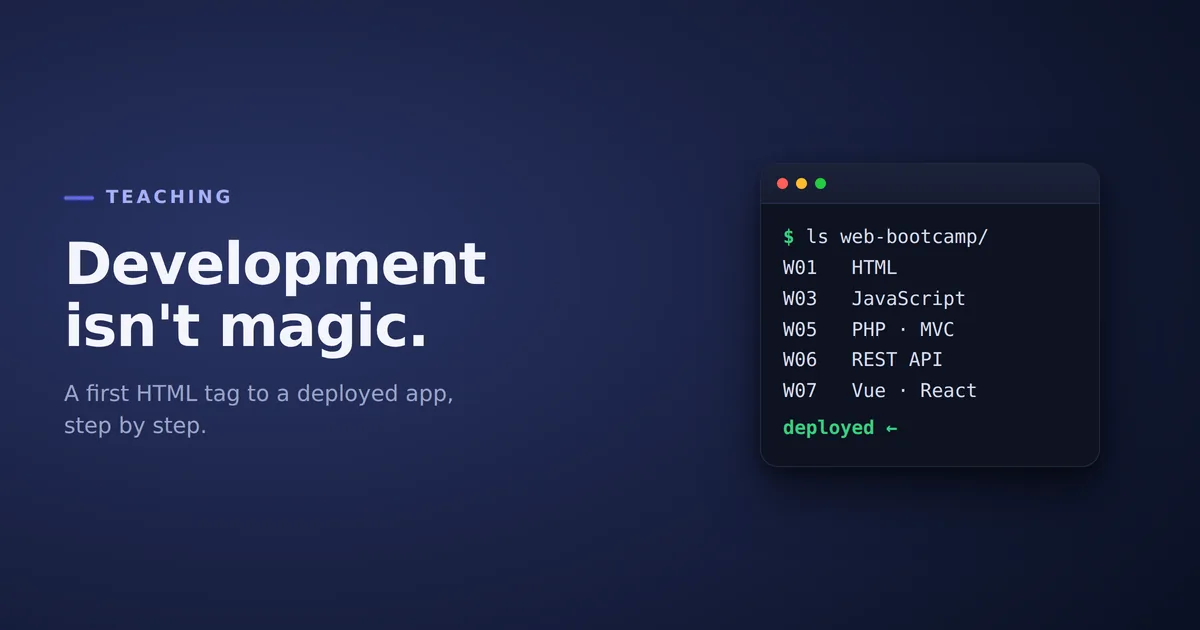
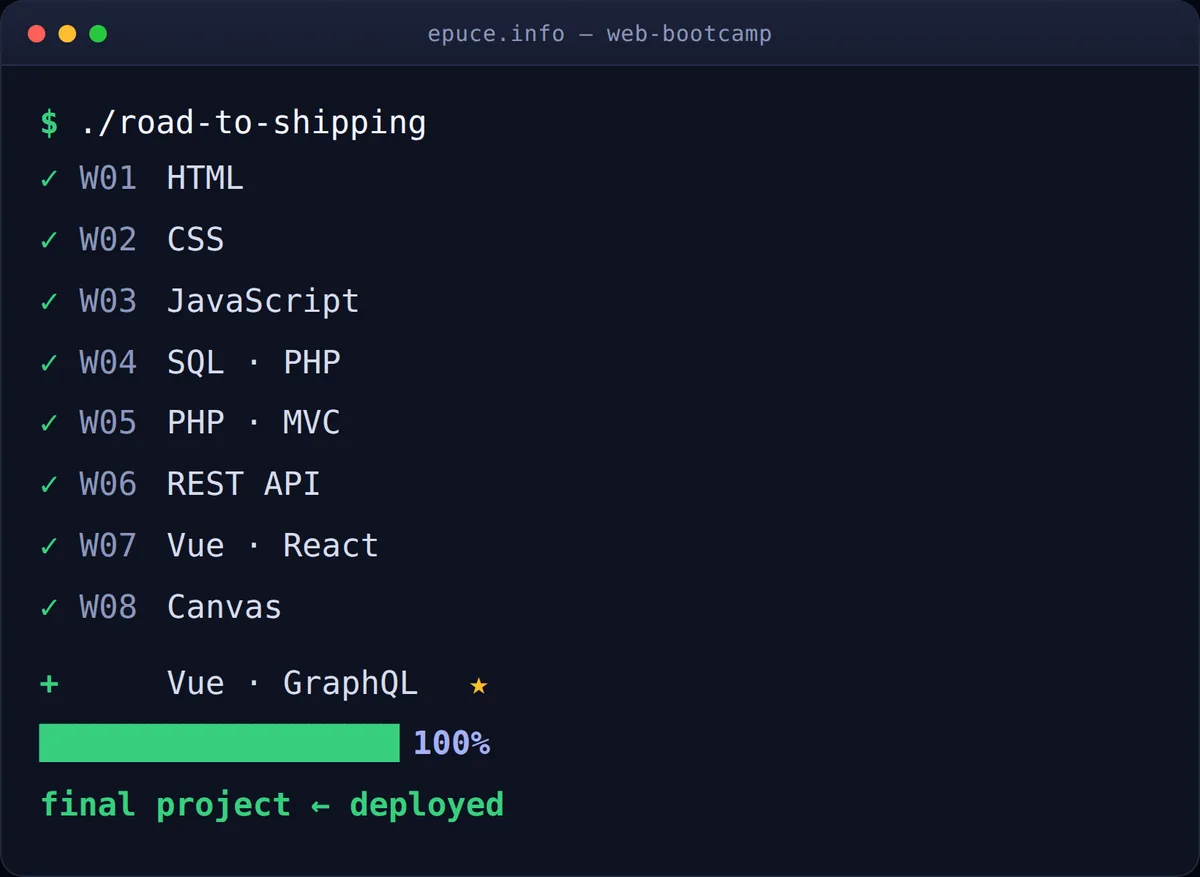
Eight weeks, plus a handful of extra lessons. Thirty-odd in all, from the very first HTML tag to an application that is tested, deployed and actually online. I wrote all of it, and I taught all of it.
I did it for one simple reason: I am tired of people believing that building for the web is a kind of magic, something reserved for a special few, as if the rest of us had missed the sign-up sheet. It isn't. It never was. So I built a course to prove it.
Development isn't magic, it's yours to learn
The stereotype I keep running into is that a developer is some sort of wizard, staring at a black screen full of green symbols, doing things the rest of us could never hope to follow. It makes for good television. It's also completely wrong, and it quietly talks a lot of capable people out of ever trying.
The truth is far less dramatic. Development is a stack of small, ordinary skills, each one learnable on its own, stacked in the right order. You start with a single tag that puts a word on a page. Then you learn to style it. Then to make it react to a click. Then to remember something in a database, to serve it from a server, to test it so it keeps working, and finally to put the whole thing online where anyone can reach it.
None of those steps is magic. Each is just the next small thing, and the course walks through them in exactly that order, one week at a time.
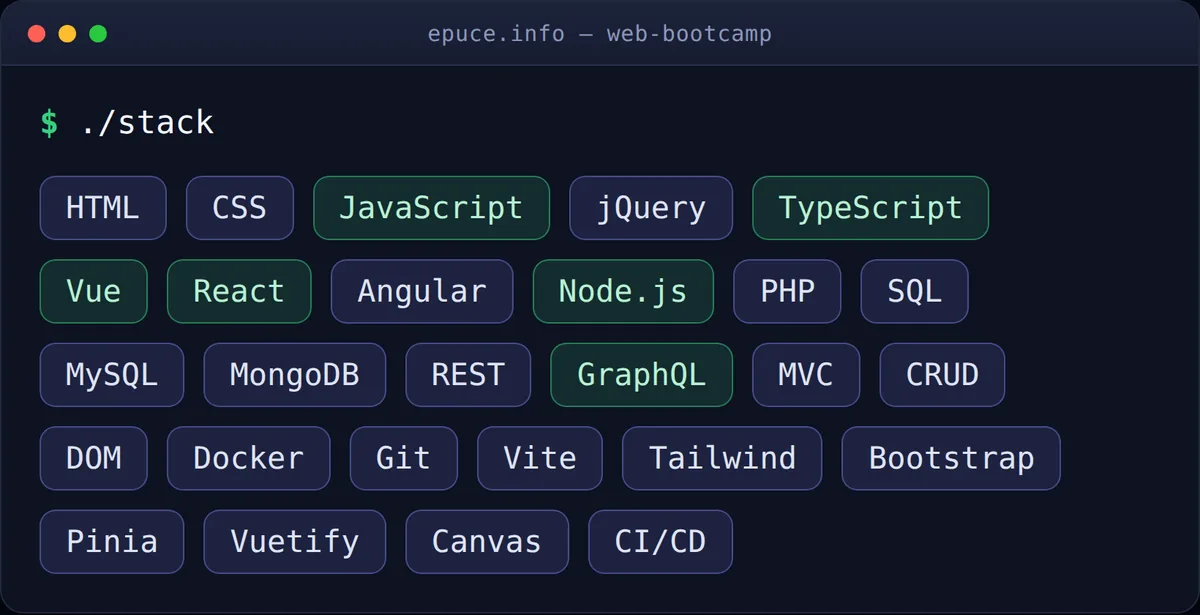
I don't teach slides, I teach building
I have sat through enough lectures to know how little of a lecture survives the walk home. So this course isn't a stack of slides you nod along to. Every single lesson ends with your hands on the keyboard, building something that runs.
You don't finish a week having heard about how layouts work. You finish it with a layout you laid out yourself. You don't finish the backend weeks having been told what a database is for. You finish them with an application that reads and writes real data. The final week ends the only way it honestly can: with a real project, deployed, that you can open in a browser and send to your parents.
That hands-on bias is deliberate. You do not learn to build by watching someone else build, any more than you learn to swim by reading about water. You learn by getting it wrong in a safe place, working out why, and fixing it. The whole course is designed to give you that safe place, over and over, until the wrongness stops being scary and starts being the normal, fixable part of the job that it actually is.
Learn it on your own, or learn it with me
Because I think knowledge like this should be shared, not gatekept, the entire course is open. All of it, every lesson, is out in the open on the web for anyone to read and work through at their own pace, for free. If you are the kind of person who just needs the map and will happily walk the road yourself, that is genuinely all you need. Take it and go.
But not everyone learns best alone, and that is not a weakness. When you are stuck at eleven at night, the difference between giving up and breaking through is often just one person who has been stuck in the same place before. So the same course is also available with me alongside you: reviewing your work, answering the "why doesn't this run" questions, and pointing you at the next small thing when the path stops being obvious.
Same material, two ways to take it. The self-guided route costs you nothing but your time. The mentored route costs a little more and saves you a lot of the lonely, spinning-your-wheels kind of stuck. Both end in the same place: you, having built something real, knowing you can do it again.
The point
Really, I built this to lower the barrier. The entry level into this field is higher than it needs to be, not because the work is genuinely that hard, but because so much of it is written as if you already know it. I wanted a door closer to the ground, and a clear starting point for the person who is looking for one and doesn't know where to begin.
So that is the whole job I set myself here: take the mystery out, put the keyboard in front of you, and stick around long enough for it to click. Come read it on your own, or come do it with me. Either way, I'd love to be proven right about you.